Flying Club Management Software: Bookings, Flight Logs and Member Billing in One Place
Pilot-Next is flying club software for clubs that are run by their own members. Members book the aircraft and log Hobbs or Tacho time after the flight; every flight they settle becomes an invoice on their account balance. The club's booking rules, membership dues and maintenance plans live in the same place. Below: how one flight runs through it, who in the club uses which part, what it costs at your club's size, and what it does not do.
No credit card. Free for 1 aircraft and 1 pilot; €9/month (billed annually) for a club aircraft shared by up to 5 pilots.
What does flying club management software do?
Flying club management software replaces the booking sheet, the hours spreadsheet and the treasurer’s monthly invoice run with one system: members book the aircraft, log the flight, and are billed for it. Pilot-Next is flying club software built around that chain. A member books a slot, enters the Hobbs or Tacho reading after the flight, and Pilot-Next prices the hours at the club’s rates and books one invoice to that member’s account balance. Membership dues, the club’s booking rules and the maintenance plans of each aircraft run in the same system, and it costs one subscription per club: free for 1 aircraft and 1 pilot, €45 a month billed annually for unlimited aircraft and pilots.
How does a club flight go from booking to invoice in Pilot-Next?
In four steps. A member books a free slot; a booking that overlaps another confirmed booking on the same aircraft is refused, and so is one that breaks a limit the club has set. After the flight the member settles the booking by entering the meter readings — once per booking, however many legs were flown. Pilot-Next multiplies the hours by the hourly rate that applies to that aircraft and pilot, adds each per-booking charge and each manual item such as landings, applies the VAT rate set on each rate, and creates one invoice that is debited to the member’s account balance. The reading then counts toward the aircraft’s hour-based maintenance plans: the Tacho reading, or the Hobbs reading on an aircraft without a Tacho meter. A flight settled as a service flight is logged without an invoice.
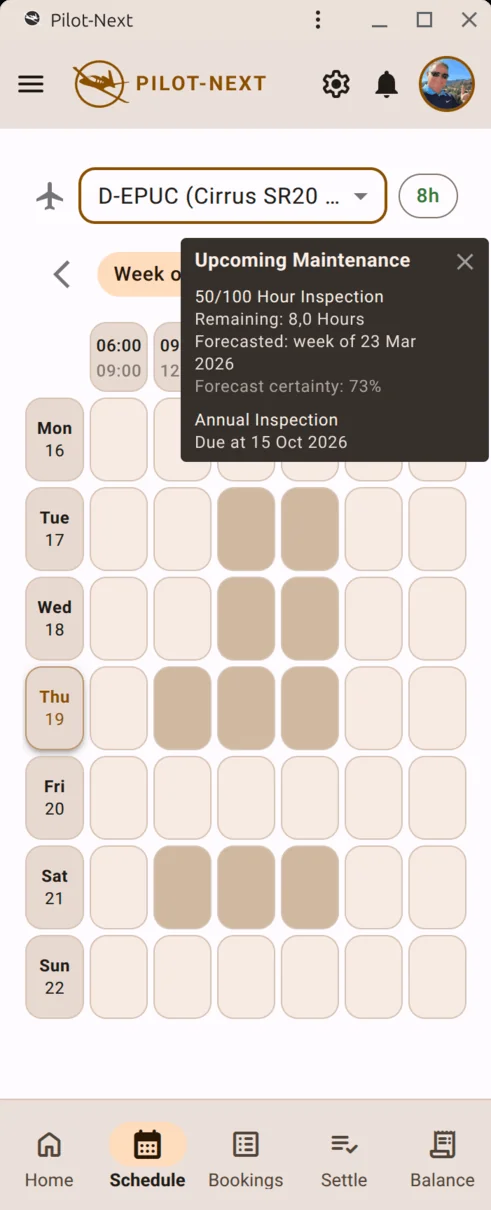
1. Book
A member picks a free slot. An overlap with another confirmed booking is refused, and so is a booking that breaks a limit the club has set.
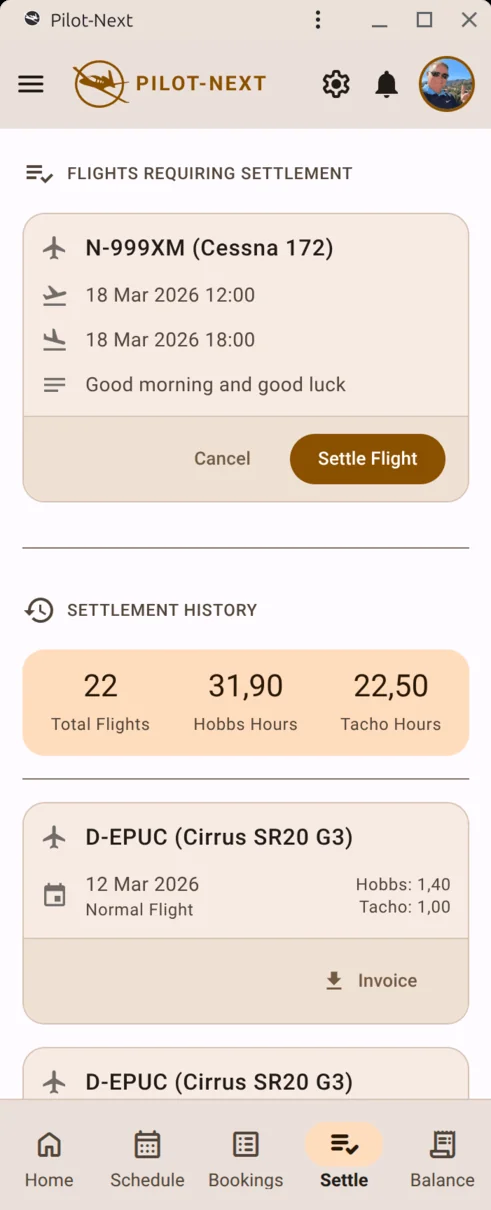
2. Fly and settle
After landing the member enters the Hobbs or Tacho reading against the booking. One booking is settled once, however many legs were flown.
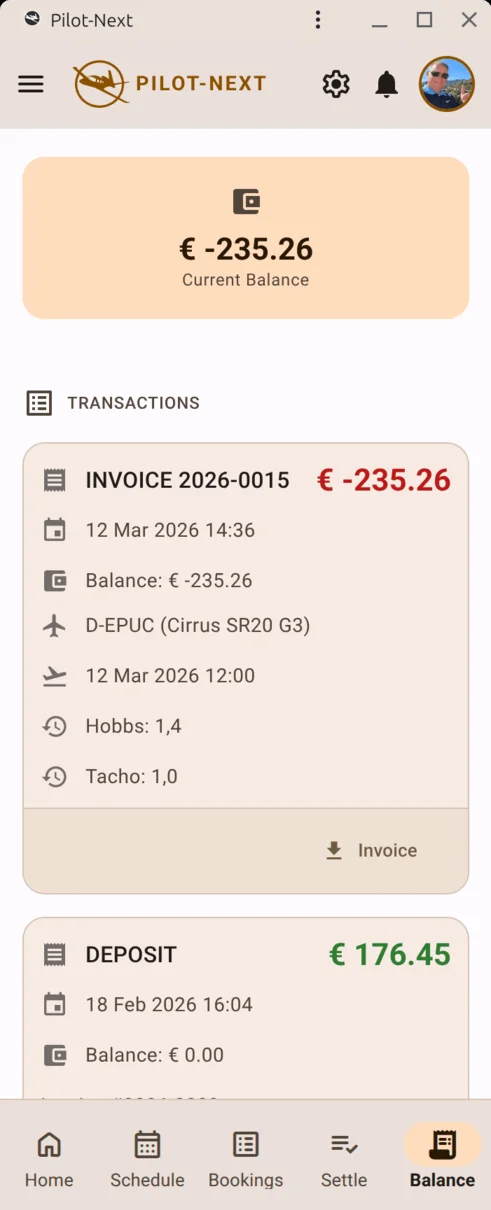
3. Invoice on the balance
The hours are priced at the club’s rates and become one invoice, debited to the member’s account balance. The treasurer records deposits against it.
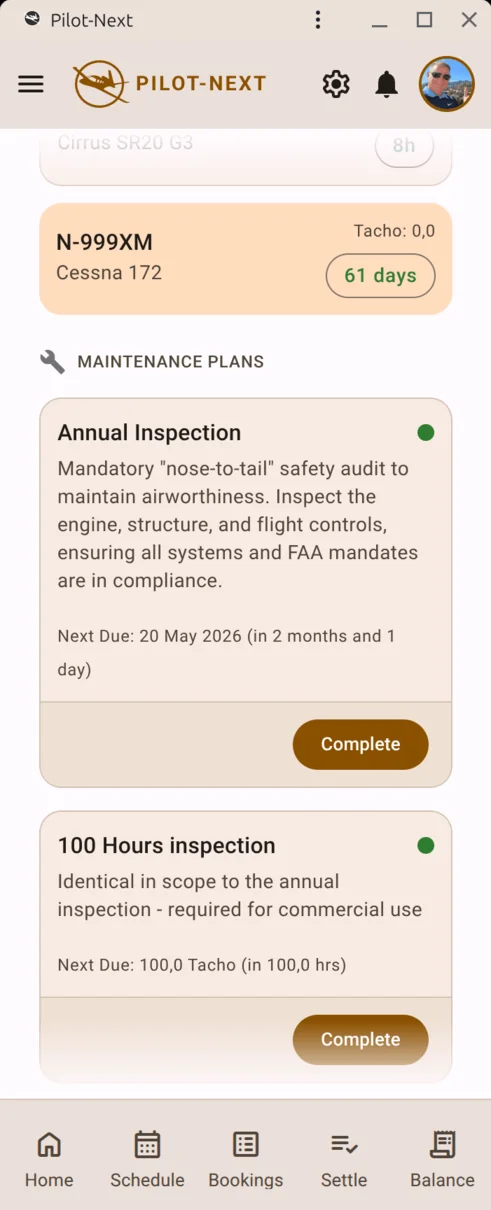
4. Hours count toward maintenance
The reading moves the aircraft’s hour-based maintenance plans toward the next due reading — Tacho, or Hobbs on an aircraft without a Tacho meter: OK, Due Soon or Overdue.


Whether to bill on Hobbs or Tacho time is a default per aircraft, which a pilot's own billing preference can override where the aircraft has both meters; why one booking is settled once is in settle per booking, not per flight.
Who in a flying club uses which part of Pilot-Next?
Members book, settle their flights and follow their own balance. The officers each get the part of the club they are responsible for: the booking officer sets the booking rules and can ground an aircraft, the treasurer sets rates and dues and records payments, and the maintenance officer keeps the maintenance plans. In Pilot-Next the officers are administrators; a club decides which of its members get that role.
| In the club | What they do in Pilot-Next | In detail |
|---|---|---|
| Members | Book a free slot on the schedule, get a calendar invite for it unless they switch that off, enter the Hobbs or Tacho reading after the flight, and see every invoice and deposit on their own account balance. | Scheduling |
| The booking officer | Switches on the club’s booking rules — a maximum booking length, a maximum number of open bookings per member, how many days ahead a member may book, a minimum balance to book — can make member bookings wait for approval, and can ground an aircraft for a period with a reason. | Booking rules |
| The treasurer | Sets a rate per hour or per booking, per aircraft or per pilot, each with its own VAT rate; bills monthly, quarterly or yearly dues and one-off joining fees; records deposits and payments on each member’s balance; and, with invoice export switched on, receives each flight invoice by e-mail as a PDF plus a UBL e-invoice file for the bookkeeping. | Billing and dues |
| The maintenance officer | Gives each aircraft maintenance plans with an interval in flight hours, in calendar months or both. Each plan shows OK, Due Soon or Overdue, and for an hours-based item Pilot-Next forecasts from the confirmed bookings when the hours will run out. | Maintenance tracking |
Each guide goes into one part: the rules 17 clubs publish and what Pilot-Next enforces of them, how clubs bill flight time and dues, and which inspections a club aircraft has to track.
What does Pilot-Next cost for a flying club?
Pilot-Next charges one subscription per club, set by the number of aircraft and pilots, not a fee per aircraft or per member. SOLO is free forever for 1 aircraft and 1 pilot; BASIC costs €9 a month for 1 aircraft and 5 pilots, PRO €18 a month for 2 aircraft and 10 pilots, and ULTRA €45 a month for unlimited aircraft and pilots, all billed annually. Booking, flight logging, invoicing, dues, booking rules and maintenance tracking come with every plan, including the free one.
| Club | Plan | Per month | Per year |
|---|---|---|---|
| One aircraft, five members | BASIC | €9 | €108 |
| Two aircraft, ten members | PRO | €18 | €216 |
| Two aircraft, thirty members | ULTRA | €45 | €540 |
| Five aircraft, sixty members | ULTRA | €45 | €540 |
The plan is the smallest one whose aircraft and pilot limits cover the club; paid plans are billed annually, so the yearly amount is what the club pays. What the same club pays on platforms that charge per aircraft is worked out in flying club management software compared.
Start free on SOLOWhat does Pilot-Next not do for a flying club?
Pilot-Next does not schedule instructors with the aircraft and does not check a pilot’s medical, licence or currency before a booking, so a club that trains students will miss both. In the app an overdue inspection does not block bookings by itself: an administrator grounds the aircraft. Dues are not prorated for a member who joins mid-period, and there is no built-in minimum-hours or no-show charge. Members’ payments are not collected by card or direct debit; the treasurer records each deposit or payment on the member’s balance. There is no QuickBooks or Xero integration — with invoice export switched on, each flight invoice is e-mailed to the club’s bookkeeping address as a PDF plus a UBL e-invoice file, and a connection to Exact Online (Netherlands) is available on request. It is a web app that can be installed on a phone’s home screen, not an app from the App Store or Google Play, and it does not replace the aircraft’s logbooks.
A club that needs instructor scheduling or currency checks will find which platforms say they offer them in the scheduling comparison; why the scope stops where it does is in what Pilot-Next deliberately doesn't do.
How does a flying club start with Pilot-Next?
Create a free account, fill in the club’s details, add the aircraft and its meters, set the rates, add the maintenance plans and then add the members, who each receive an e-mail invitation to set up their own account. The free SOLO plan covers 1 aircraft and 1 pilot, enough to set everything up and book and settle a first flight; a club with more pilots moves to BASIC, PRO or ULTRA before it adds them.
- Create a free account. Every club starts on SOLO, which is free for one aircraft and one pilot and asks for no payment details.
- Fill in the club’s details. Address, bank account and VAT number, and a logo if you have one: they are printed on every invoice.
- Add the aircraft. Registration, type, which meters it has — Hobbs, Tacho or both — and which of them it is billed on by default. The opening meter reading is entered with the first flight you settle.
- Set the rates. A rate for all aircraft or one per aircraft, per hour or per booking, and a different rate for a particular pilot where the club has one.
- Add the maintenance plans. The annual, the 100-hour inspection and any recurring item, in hours, in months or both.
- Add the members. A second pilot needs BASIC or higher. Each member you add receives an e-mail invitation to set up their own account.
Can members book the club aircraft through an AI assistant?
Yes. Pilot-Next runs a remote MCP (Model Context Protocol) server, so a member can ask Claude or another MCP-aware assistant when the aircraft is free, book it or settle a flight. The assistant works with that member’s own permissions, and the club’s booking rules apply to a booking made this way just as they do in the app. The assistant also refuses a booking that would run past the hours left to the aircraft’s next inspection.
The tools and how to connect: the Pilot-Next MCP server.
Does Pilot-Next work for a flying club in Europe?
Yes. Pilot-Next is built in the Netherlands and priced in euros. A club invoices its members in its own currency, sets a VAT rate on every rate, has its IBAN and VAT number printed on each invoice, and its data is stored in Frankfurt, Germany.
Currencies, VAT, e-invoices and the European platforms side by side: flying club software for European clubs. For a group of co-owners rather than a club: aircraft partnership software; for renting aircraft out to pilots: aircraft rental software. What a club aircraft costs per flight hour: aircraft ownership cost calculator; starting a club from scratch: how to start a flying club.