Settle per booking, not per flight
April 24, 2026 · Chris van Eijk · Updated October 5, 2026
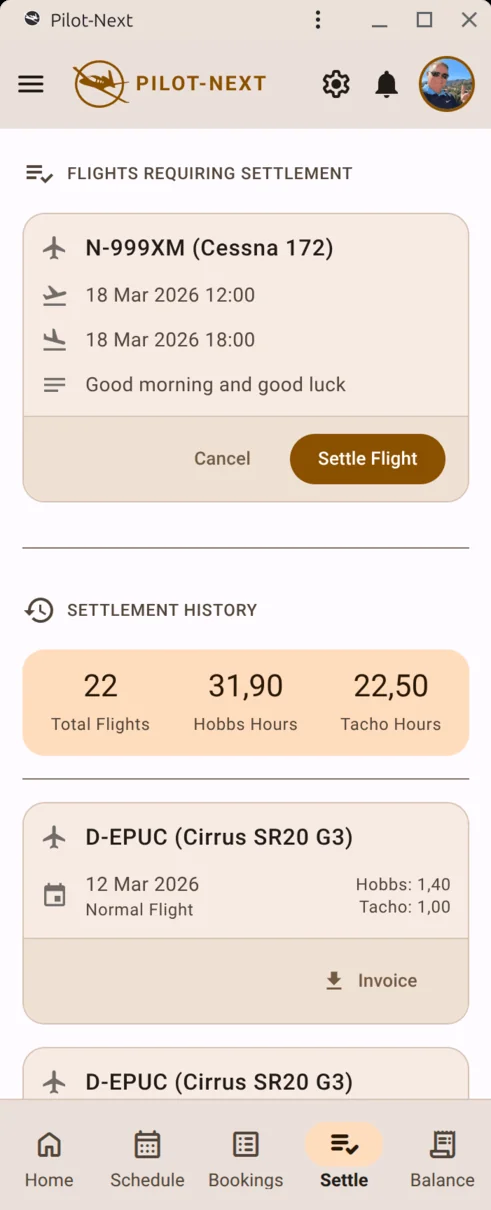
Most aircraft management tools ask for too much information at settlement time. Origin, destination, route, time off, time on, landings per leg, engine starts, fuel at each stop. For logging — yes, all of that matters. For cost allocation — almost none of it does.
Pilot-Next is a settle-per-booking system. You block an aircraft for a window, you fly one leg or five, you come back, and you record two numbers: Hobbs (or Tacho) start and end. That's the settlement. Everything else is someone else's job.
The two numbers
Imagine a weekend trip: home field to the next one over for breakfast, onward to meet a friend for lunch, then back home. Three legs. Three take-offs, three landings.
For the logbook, those are three separate entries. Your logbook app cares about routing, PIC time per leg, night and instrument time, and your landing currency.
For the shared aircraft's accounting, none of that matters. What matters is: how many engine hours came off the airframe between when you picked it up and when you put it back? Multiply by the hourly rate. Invoice. Done.
Three legs, one settlement
Pilot’s logbook
3 entries — route, PIC time, landings per leg
- Home field → breakfast stop
- Breakfast stop → lunch with a friend
- Lunch → home field
Shared aircraft’s books (Pilot-Next)
1 flight log for the booking
Why per-leg settlement is admin overhead
Clubs that settle per-leg ask every pilot, after every flight, to enter:
- Origin
- Destination
- Hobbs start and end for this leg
- Tacho start and end for this leg
- Optional: squawks, fuel, oil
For a 3-leg day that's 3× the data entry for the same invoice line. The pilot didn't enjoy it. The treasurer didn't need it. Nobody benefits.
What per-booking settlement looks like
Open the aircraft at 10:00. Hobbs: 2,834.2. Close the aircraft at 16:20. Hobbs: 2,839.8.
That's 5.6 hours × hourly rate. One flight log. One invoice. Everyone moves on.
If the pilot wants to log three legs, they log three legs in their logbook app of choice. The aircraft operator's ledger doesn't need to know about them.
When does per-leg matter?
If you have rate structures that depend on where you were — a different landing fee at every airport, overnight fees at specific destinations, differential rates by region — you need per-leg data. Most partnerships don't. Most clubs don't. The rate is flat-hourly, and "where you went" is out of scope for cost allocation. A fee charged per unit — a landing fee per landing, fuel per whole litre — needs no legs either: the pilot enters the quantity with the flight.
Pilot-Next deliberately keeps no per-leg records: a booking has one flight log, with the meter readings at pick-up and return, the quantities of per-unit items such as landings, and room for remarks. Settlement is always at the booking level: one window, one pair of meter readings, one invoice. The legs belong in the pilot's own logbook.
The mental model
The airframe is a meter. You read it on the way in, you read it on the way out. The delta is what you owe.
The content of what you did with the airplane during that block — the legs, the approaches, the instructional content — belongs to your logbook, your instructor, the regulator, or your own records. Not to the shared-aircraft treasurer.
Design a settlement tool around that principle and the admin goes away.
Wondering what that hourly rate should be in the first place? The aircraft ownership cost calculator splits an aircraft's costs into a fixed share per owner and a variable rate per flight hour. And whether that rate should be wet or dry, on Hobbs or Tacho, prepaid or invoiced is worked through in how a flying club should bill its pilots for flight time.