Hobbs vs Tacho: what actually counts when splitting costs
April 25, 2026 · Chris van Eijk · Updated October 24, 2026
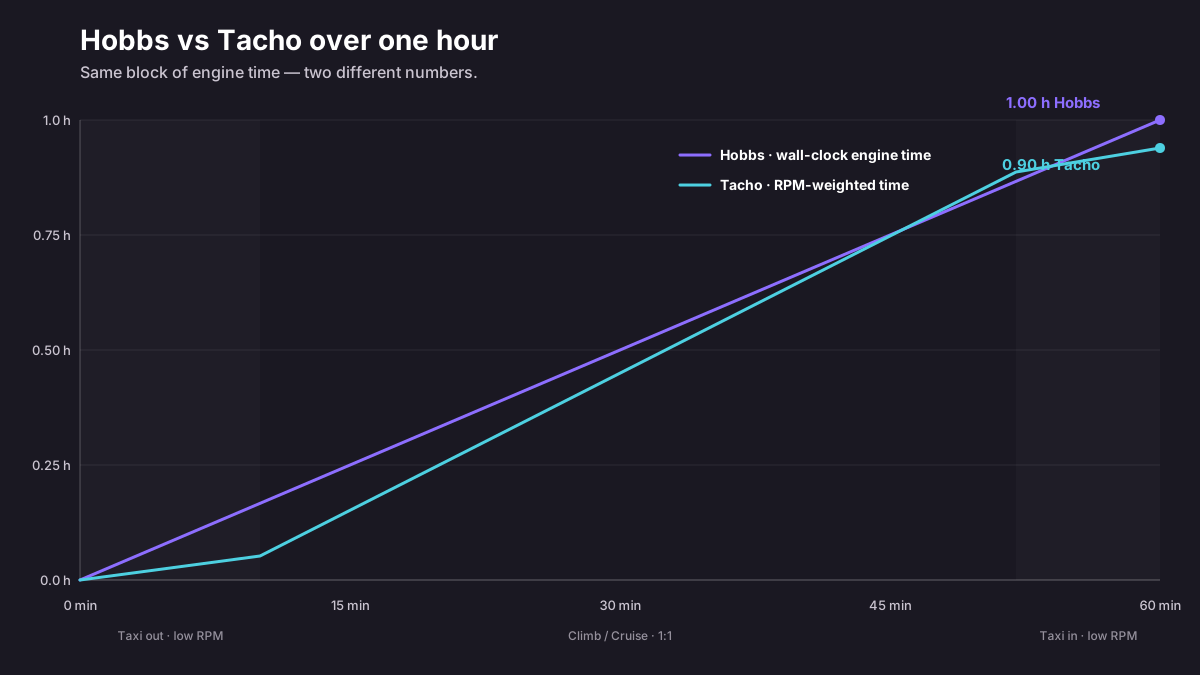
Every shared-aircraft treasurer eventually hits this question: do we bill by Hobbs or Tacho? The two meters sit side by side on most panels and count time differently. The difference shows up on every invoice. It's worth being explicit about which one you use — and why.
Short answer: a flying club can bill on either meter, and nine of the 17 clubs we checked bill on Tacho, three on Hobbs. Tacho tracks engine wear more closely and suits a club that funds its overhaul reserve per hour; Hobbs is simpler to read and charges for all engine-running time, taxi included. What matters more than the choice is the rate: Tacho reads fewer hours than Hobbs for the same flights, so a club that switches meters has to raise its hourly rate by the same proportion — the table below shows by how much.
What each meter measures
Hobbs runs whenever the engine is running (and typically while oil pressure is above a threshold, or while the master is on — it depends on the airframe and installation). In practice, Hobbs is wall-clock engine-running time.
Tacho — tach time in the US — runs at a rate proportional to engine RPM, calibrated so that one "Tacho hour" equals one hour at the instrument's reference RPM, a cruise setting. That reference differs per tachometer, so check your own; the example below uses 2,300 RPM. Taxi and low-power ground operations accumulate Tacho time slowly; cruise at the reference RPM accumulates it 1:1.
Same block of engine time, two different numbers. A flight with long taxi and a short cruise leg might read 1.2 Hobbs and 0.9 Tacho.
Where the difference comes from is easiest to see phase by phase. On the ground the engine idles at low RPM, so Hobbs keeps counting while Tacho barely moves; in cruise at the reference RPM the two count alike, and above it — take-off and climb — Tacho runs slightly faster.
One flight, two meters: 1.2 Hobbs, 0.9 Tacho
| Phase | Minutes counted |
|---|---|
| Start-up and taxi outabout 1,000 RPM | Hobbs 15Tacho 6.5 |
| Run-upabout 1,800 RPM | Hobbs 4Tacho 3.1 |
| Take-off and climbabout 2,500 RPM | Hobbs 8Tacho 8.7 |
| Cruiseabout 2,300 RPM | Hobbs 25Tacho 25 |
| Descent and circuitabout 1,900 RPM | Hobbs 10Tacho 8.3 |
| Taxi in and shut-downabout 1,000 RPM | Hobbs 8Tacho 3.5 |
| Whole flight | Hobbs 70 min = 1.2 h · Tacho 55 min = 0.9 h |
Which one reflects engine wear?
Tacho is closer. Engine wear is driven mostly by RPM-hours at power, not by minutes of ground idle. The whole point of tachometer-based time is to measure the work done by the engine — which is what correlates with time to overhaul.
If your aircraft's overhaul reserve is being funded per flight hour, Tacho is the more defensible unit. You're charging in the same currency you're saving toward.
Which one is "fairer"?
It depends on who you're being fair to.
- Tacho favours the pilot who does a lot of training, pattern work, or short hops. Ground and taxi time don't count as heavily.
- Hobbs favours the club that wants a simple, one-to-one accounting of "aircraft in service" time, including time spent getting to and from the runway.
Many long-running partnerships settle on a hybrid: bill one meter and track maintenance on the other. In Pilot-Next each aircraft can record both meters and you pick which one drives invoicing; maintenance intervals count Tacho hours, or Hobbs hours on an aircraft without a Tacho — how hour and calendar limits work together for the 100-hour and the annual. For the inspection rules themselves the hours are "time in service", from the moment the aircraft leaves the ground until it lands (14 CFR 1.1), which neither meter measures exactly; which club flights need a 100-hour inspection at all depends on the flight, not the meter.
Which meter do flying clubs bill on?
We read the rates pages of 17 member-owned flying clubs on 6 October 2026 (re-read on 16 October 2026) — nine in the United States, four in the United Kingdom, and four in the Netherlands, Belgium and Germany. Twelve of them say which meter they bill on: nine bill on Tach (Tacho) time and three on Hobbs time. In the United States that is six of the nine clubs on Tach; in the United Kingdom three of the four clubs charge per tacho hour, and the fourth bills airborne time plus ten minutes. Of the clubs that say whether fuel is included, ten charge a wet rate and one a dry rate.
What 17 flying clubs bill flight time on
- Tach (Tacho): 9
- Hobbs: 3
- Other basis: 2
- Not stated: 3
| Club | Bills on | Wet or dry | Example rate | Rates as of |
|---|---|---|---|---|
| TSS Flying ClubUSA | Tach (Tacho) | Fuel: Wet | $175 per tach hour (Cessna 172S) | Rates as of: 26 April 2026 |
| Fox Flying ClubUSA | Tach (Tacho) | Fuel: Not stated | $104 per tach hour (Cessna 172) | Rates as of: no date on the page |
| Mitchell Flying ClubUSA | Tach (Tacho) | Fuel: Dry | $80 per hour, dry (Cessna 172R) | Rates as of: no date on the page |
| FAA Flying ClubUSA | Tach (Tacho) | Fuel: Wet | $150 per tach hour (PA-28-151) | Rates as of: 1 July 2025 |
| Hokie Flying ClubUSA | Tach (Tacho) | Fuel: Wet | $94.39 per tach hour (Cessna 172M) | Rates as of: July 2026 |
| Westchester Flying ClubUSA | Tach (Tacho) | Fuel: Wet | $144 per tach hour (PA-28-181 Archer) | Rates as of: no date on the page |
| Skyhawk Flying ClubUSA | Hobbs | Fuel: Wet | $105 per hour (Cessna 172) | Rates as of: October 2025 |
| Oregon State Flying ClubUSA | Hobbs | Fuel: Wet | $155 per hour (Cessna 172M) | Rates as of: no date on the page |
| International Flying ClubUSA | Hobbs (Cessna aircraft) | Fuel: Wet | Not on this page | Rates as of: no date on the page |
| Southport and Merseyside Aero ClubUK | Tach (Tacho) | Fuel: Not stated | £1.80 per tachometer unit (club aircraft) | Rates as of: no date on the page |
| RAF Brize Norton Flying ClubUK | Tach (Tacho) | Fuel: Wet | £160 per tacho hour (PA-28 Warrior, service rate) | Rates as of: no date on the page |
| Civil Service Flying ClubUK | Tacho (licensed pilots) | Fuel: Not stated | £247 incl. VAT per tacho hour (Cessna 172) | Rates as of: 2026 |
| Bristol Aero ClubUK | Airborne time + 10 min | Fuel: Not stated | £190 per hour solo hire (Piper PA-28) | Rates as of: no date on the page |
| Vliegclub TwenteNetherlands | Not stated | Fuel: Not stated | €169 per hour (Cessna 172) | Rates as of: 2024 |
| Sabena AeroclubBelgium | Not stated | Fuel: Wet | €216 per hour (Piper Archer III) | Rates as of: April 2026 |
| KLM AeroclubNetherlands | Airtime or Hobbs, whichever is higher | Fuel: Not stated | €220 per flight hour (Cessna 172P) | Rates as of: no date on the page |
| Fliegerclub NürnbergGermany | Not stated | Fuel: Wet | €189 per hour (Cessna 172 TDI) | Rates as of: May 2026 |
Two of the clubs say out loud why they chose their meter. Mitchell Flying Club bills "on Tach time, not Hobbs time (approximately 10% savings)"; Fox Flying Club tells members "Your hourly rate is billed on TACH time, not HOBBS time." Of the four clubs on the Continent, only KLM Aeroclub names a meter — it bills recorded airtime or Hobbs time, whichever is higher; the other three quote a price per hour without saying which clock it runs on.
What most clubs actually do
From 15 years of running partnership software and talking to clubs:
- Flight schools and partnerships with heavy taxi / pattern operations tend toward Tacho.
- Cross-country-heavy ownership groups tend toward Hobbs — the difference is small, and Hobbs is easier to read and verify.
- Clubs that fund overhaul reserve by flight hour tend toward Tacho.
None of these are wrong. The important thing is that the group is explicit about it, consistent about it, and that every invoice reflects the same meter that was recorded.
If you switch from Hobbs to Tacho, what should the rate be?
Divide the Hobbs rate by your aircraft's Tacho-to-Hobbs ratio. Over the same flights the Tacho reads fewer hours than the Hobbs, so a club that switches meters and keeps its old rate collects less on every flight, by exactly that ratio. On the flight above — 1.2 Hobbs, 0.9 Tacho, a ratio of 0.75 — a €180 Hobbs rate becomes €240 per Tacho hour, and both bill €216 for the flight.
The same flight, billed three ways
- 1.2 Hobbs × €180€216billed on Hobbs
- 0.9 Tacho × €180€162switched meter, same rate: 25% less
- 0.9 Tacho × €240€216switched meter, converted rate
Tacho rate that bills the same as a Hobbs rate of €150, €180 or €210
| Tacho ÷ Hobbs ratio | €150 | €180 | €210 |
|---|---|---|---|
| 0.75 (flight above) | €200 | €240 | €280 |
| 0.80 | €188 | €225 | €263 |
| 0.85 | €176 | €212 | €247 |
| 0.90 | €167 | €200 | €233 |
| 0.95 | €158 | €189 | €221 |
The ratio is a property of how an aircraft is flown, not a constant. AOPA puts Tach time typically 10 to 20 percent below Hobbs time, depending on the length of the flight and the power settings used — a ratio of roughly 0.80 to 0.90. A training aircraft that spends its life in the circuit sits at the low end; a touring aircraft on long cross-countries closer to 1. The way to find yours is to add up both meters over a season of flights and divide the Tacho total by the Hobbs total; an aircraft in Pilot-Next that records both meters keeps both readings on every flight log. Our free Tach to Hobbs converter does that division for you, and converts hours and hourly rates both ways at the ratio you find.
In Pilot-Next
- Each aircraft has a
defaultBillingMethod— HOBBS or TACHO. - An administrator can set a billing meter per pilot (
preferredBillingMethod), in case your club offers both options. - At settlement, the app reads the start and end of whichever meter applies, multiplies by the rate, and produces one invoice line.
No drama. Just consistent numbers feeding the ledger. The other choices behind a club's flight-time bill — wet or dry, per-booking charges, member rates, prepaid account or invoice — are set out in how a flying club should bill its pilots for flight time.
How the meter reading fits between the booking and the invoice is laid out step by step in our guide to aircraft scheduling software. And what one of those hours actually costs the owners — fuel, reserves and a share of the fixed costs — is what our aircraft ownership cost calculator works out. And if you are choosing a tool to do this for your group, here is how flying club software compares on price and features.
The real lesson
Don't agonize over the right meter. Pick one, write it into your club bylaws or partnership agreement, and apply it consistently. Switching later is fine too, as long as the rate moves with the meter. The difference between well-run books and messy books is much more expensive than the choice of meter.